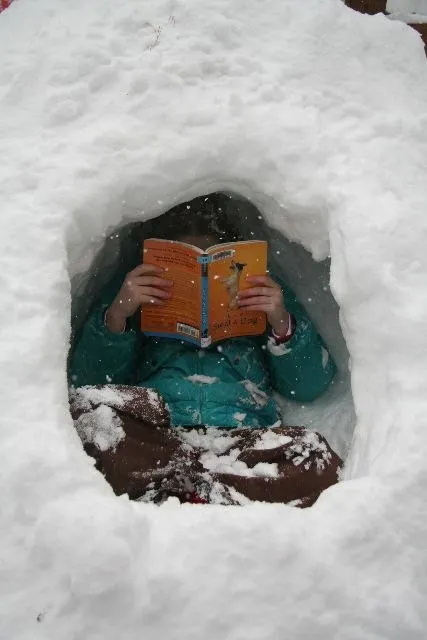
It’s cold, but my inks never freeze; I consistently keep them warm with my incessant reading habit. For me, reading begets writing.
I write my observations from books and my experiences in my journal. I do this for two reasons: to inculcate habits of precision and meticulousness, and the second is to preserve the nuggets of knowledge, for myself, and for you, dearest reader.
After all, the dullest ink is sharper than the sharpest brain.
“Children, born when winter is king, may never rejoice in the hopeful spring.” — George MacDonald
It was a bitterly blizzardy cold month in NYC in February 2026, the kind when snow stretches endlessly, and the air bites sharply at everything it touches. Winter has a prominently dull presence about it, heavy and unyielding, refusing to loosen its grip. Hence, it cues in a state of emergency.
If you’re looking for gentle tales of snow that melt into spring, this is not the place. But there’s something even better! You may sneak into the pages of the books I read in February; I went through the cold, so you don’t have to.
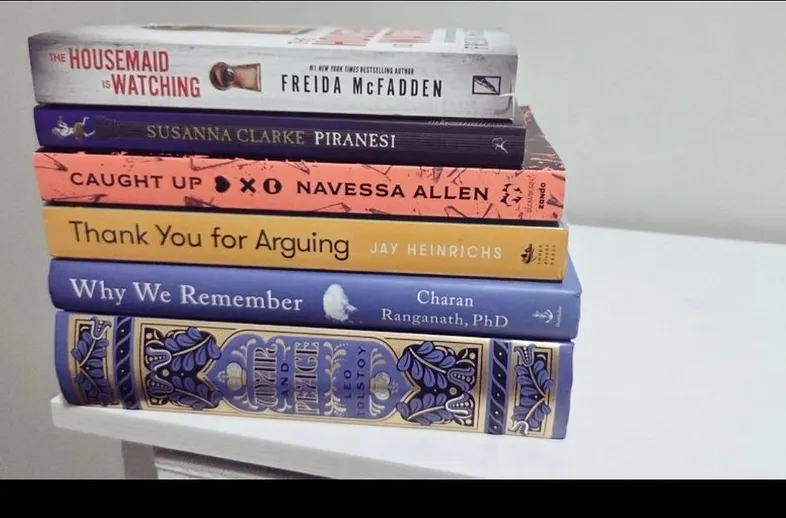
These books offered me stories shaped by endurance, silence, and warmth during the harsh winter.

Everything we see is, in some way, tied back to us. The world does not stand apart from human experience; it moves through it, responds to it, and depends on it. Books are no different; they contain whole communities within them, voices, lives, and ideas that lean on one another, quietly connecting across time and space.
Reading these books, I felt a longing for things beyond my reach, something behind the words, like a half-forgotten life, blurred variations of the future, and an incessant longing and obsession for clarity and understanding. This is what keeps me returning to books, not just for the stories, but for the way they echo something familiar, something fundamentally human, that I know nothing still, thence, I must read with all humility
These are the books I read in February 2026. Each one of them was a companion during winter; they offered me warmth through the cold, meaning, and a sense of purpose that outlasted the cold.
Piranesi — Susanna Clarke
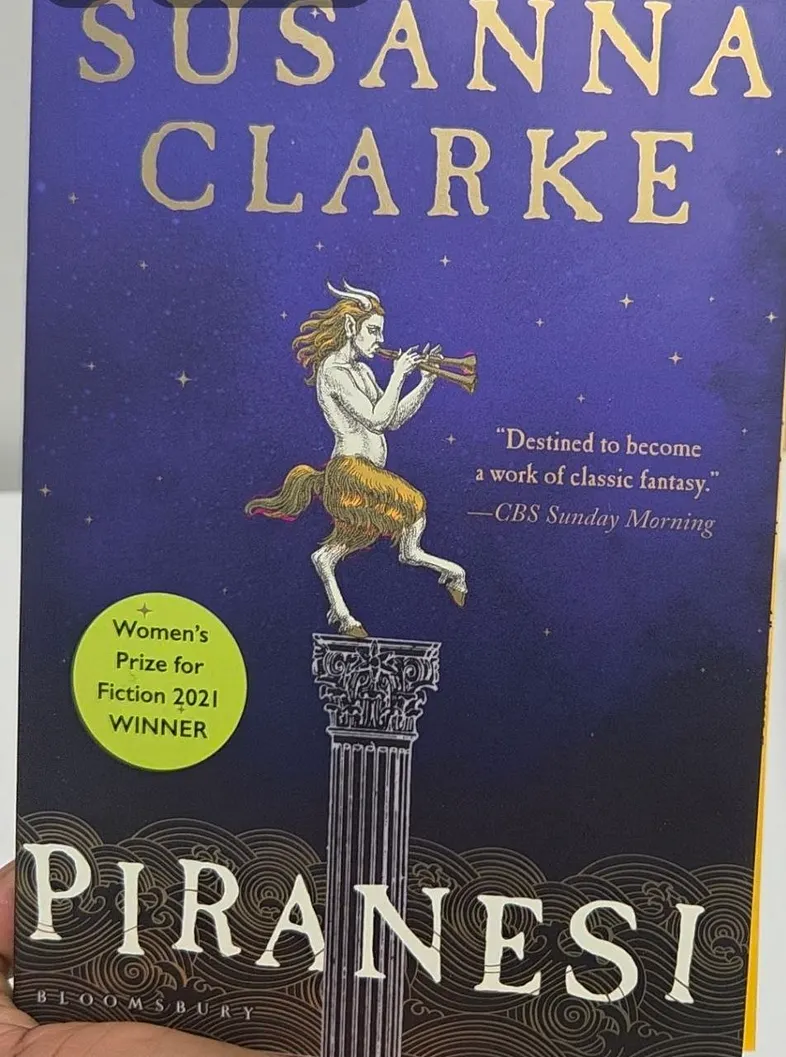
This experience led me to form a hypothesis: perhaps the wisdom of birds resides not in the individual, but in the flock, the congregation — Susanna Clarke, Piranesi
I didn’t discover Piranesi on my own. It came from a friend who loves vampire tales and fantasy, the kind of reader always chasing strange, immersive worlds. At the time, I assumed it was just another fantasy pick.
It wasn’t.
Reading it felt less like entering a story and more like stepping into a space, strange, quiet, and endlessly unfolding. Perhaps the immersive world should be embraced. The book asks you to notice, to linger, to piece things together slowly. It kept returning me to one unsettling question: who are we if we cannot remember where we came from?
Piranesi writes everything down, carefully and faithfully, and that instinct resonated with me immediately. Writing forces attention, precision, honesty and perhaps leaves something behind for the world. I am probably the Piranesi of this digital age, lol.
Some moments are almost disarmingly simple, calm as watching birds, noticing patterns, understanding that sometimes wisdom isn’t in the individual, but in the collective. It reminded me of an older way of seeing the world, where reality could respond to you, converse with you, even be persuaded. This was the way it was until something changed within us; we stopped listening. The world didn’t just grow quiet; it became something more fixed, more distant. Piranesi brings back that sense of wonder, asking you to pay attention again to the stillness.
It was the perfect book for midwinter: stripped-down and thoughtful. After it, the next book felt sharper, more urgent, less about listening to the world, more about reading people.
The Housemaid Is Watching — Freida McFadden
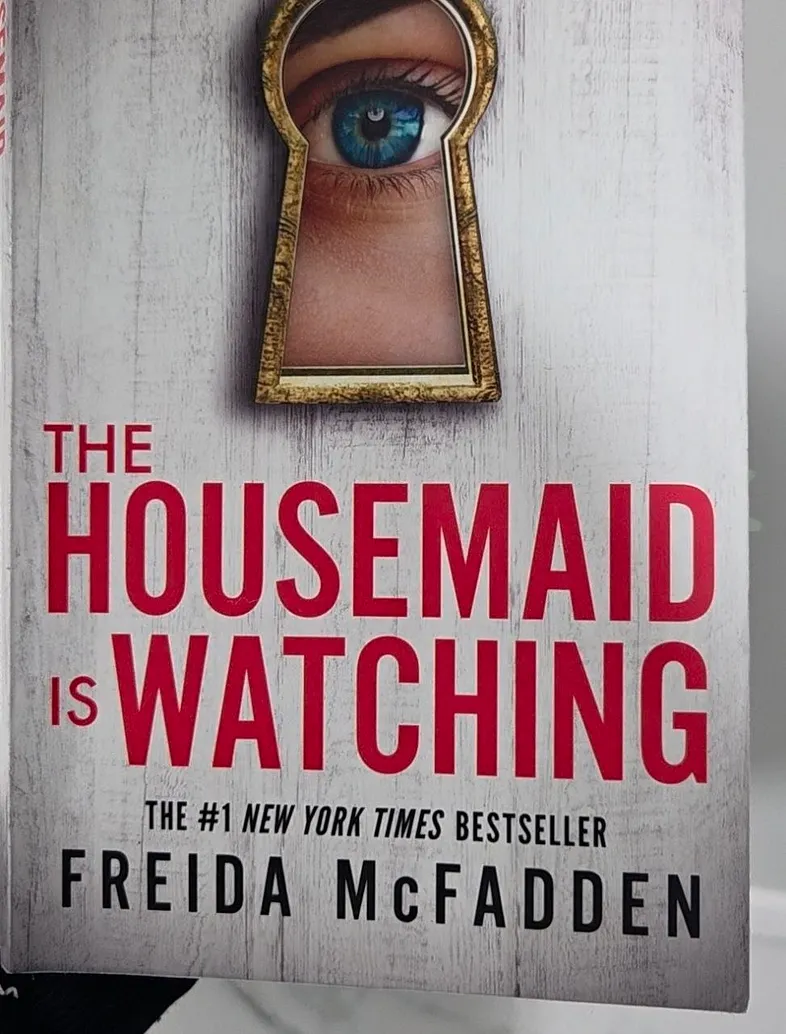
Nothing’s wrong. I’m fine. I just want to read.” ― Freida McFadden, The Housemaid Is Watching
“Telling someone to be themselves is like the worst advice ever. Don’t you hate it when someone says that to you?”
The Housemaid Is Watching is a psychological thriller that doesn’t give you a breather. It moves fast, with sharp twists that keep you slightly off-balance. Freida McFadden has a way of making you question every character, every detail, every assumption you thought was safe.
What stayed with me most wasn’t the plot itself, but the quiet, persistent idea that people reveal themselves constantly, if you pay attention closely enough.
The book revolves around secrets, deception, trust, and marriage, all wrapped in a polished suburban facade where everything looks perfect. But of course, it never is. It reminded me how little we truly know about what happens behind closed doors. Sometimes the people who seem the warmest, most composed, are the ones hiding the most. Danger doesn’t always look like danger; sometimes it smiles.
The story also plays with another unsettling idea: the safest place might be the one that first feels wrong. Instinct and reality don’t always line up. What seems like luck might not be luck at all; sometimes it’s something you were led into, not something you found.
Nothing is free in Freetown.
This book pushed me to observe people more carefully. How we so often label behavior as “weird” or “off,” instead of asking why. Curiosity over judgement! And by far, curiosity is more useful than judgment. Strange actions might not be a warning; they could be a door you haven’t yet figured out how to open.
In a way, it connects to Piranesi, but in reverse. That book asked whether the world is speaking to us. Here, it’s whether people are and whether we’re truly listening. They tell on themselves, not always directly, but in fragments, in reactions, in what they avoid as much as what they say. You just have to notice, pay attention.
After the tension and suspicion of The Housemaid Is Watching, I turned to something more deliberate, less about reading people in the moment, and more about understanding how and why we try to move one another.
Thank You for Arguing — Jay Heinrichs
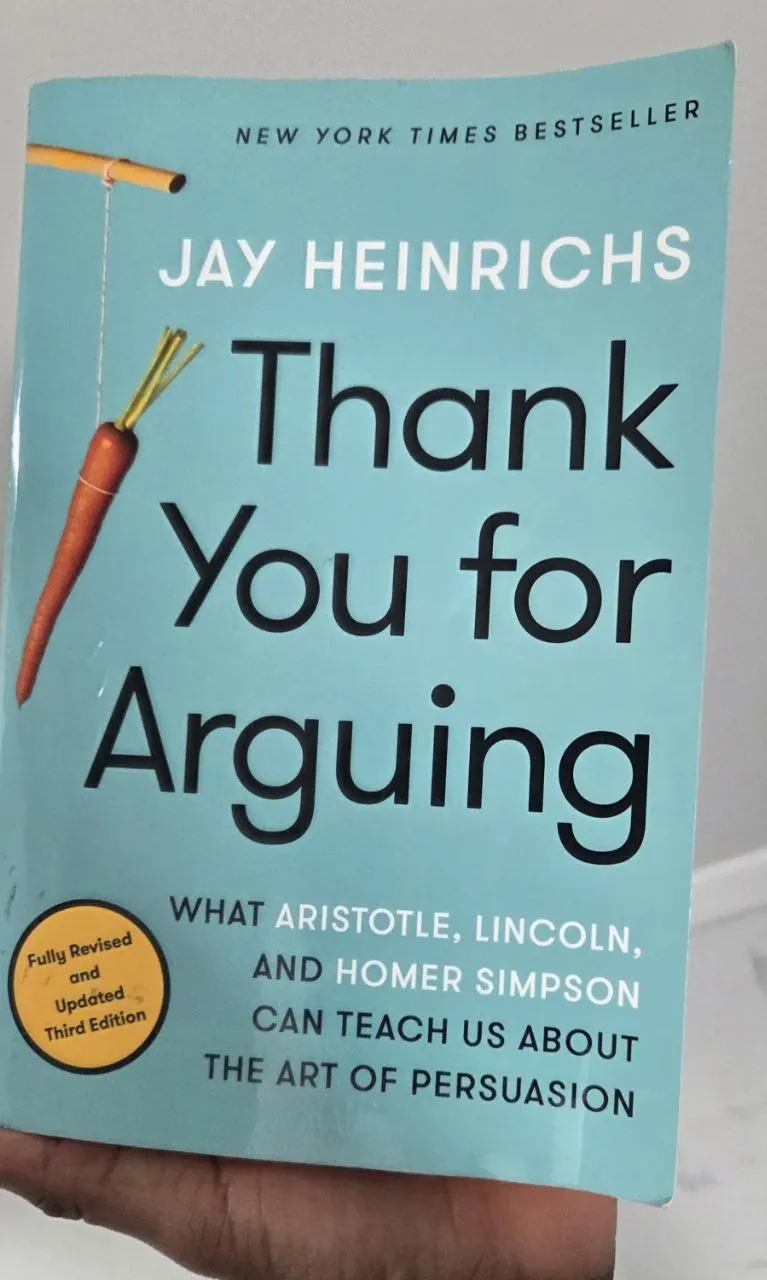
Rhetoric is the art of influence, friendship, and eloquence, of ready wit and irrefutable logic. And it harnesses the most powerful of social forces, argument. ― Jay Heinrichs, Thank You for Arguing
Parents spare the rod these days, but they still employ the rhetorical stick, you’ll take piano lessons, and you’ll like them. The tone determines whether that’s a hopeful prediction or argument by the stick.
Have you ever met unbelievable people? You ask, “What apple do you want”? They say blue! Are you kidding me? Well, thank you for arguing. Next time, you probably frame the question differently: Green or red apples, which?
Thank You for Arguing by Jay Heinrichs is a masterclass in persuasion, showing how arguments are less about winning and more about guiding understanding. It’s practical, precise, and endlessly revealing, teaching you not only how to influence others, but why people respond the way they do. It was an absolutely enlightening read!
At its core, the book reminded me that logic alone rarely moves anyone. People act because they desire something, feel heard, or are part of a group. Arguments are not battles; they are conversations in which timing, framing, and empathy matter more than force.
What stayed with me were the truths beneath the techniques: there are as many reasons to argue as there are situations. Some people simply need to be heard; others need to feel involved; some act irrationally yet passionately, and often for reasons we might not immediately see. Even children are lessons in persuasion, curious, stubborn, and drawn to proof in ways that adults forget.
The book also reminded me of humility in conversation. As Montaigne puts it, when we express opinions, we reveal the measure of our sight, not the measure of the thing. In a world tearing itself toward external truths, perhaps the wisest approach is curiosity, patience, and a willingness to listen even in disagreement.
After the quiet observation of Piranesi and the scrutiny of human behavior in The Housemaid Is Watching, this book shifted my focus outward: from noticing and interpreting the world to understanding how we influence, connect with, and move one another.
Why We Remember — Charan Ranganath
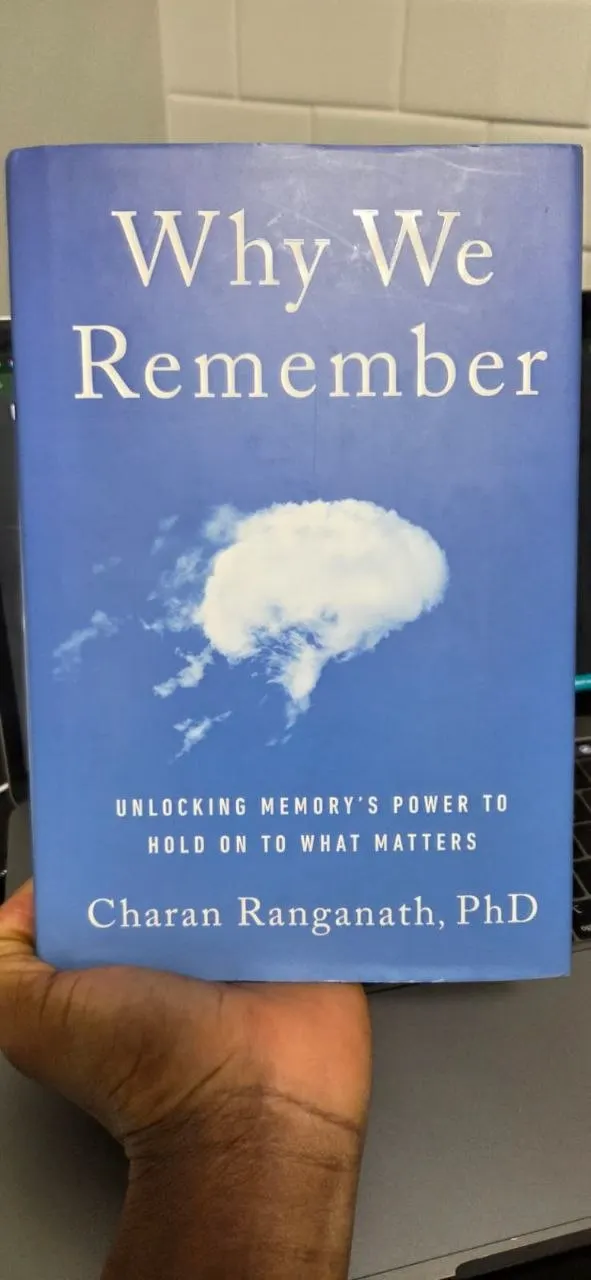
Memory is much, much more than an archive of the past; it is the prism through which we see ourselves, others, and the world.” ― Charan Ranganath, Why We Remember
You probably have experienced walking into a room and having no memory of why you went there in the first place. This doesn’t mean you have a memory problem; it’s actually a normal consequence of event boundaries. You are not dull, lol.
Why We Remember explores memory as a dynamic living process. The experiencing self lives through the moment, but the remembering self shapes choices. Happiness rarely comes from raw experience; it comes from how we recall it. Memory is reconstructed, imagined, and shaped by perspective, emotion, and belief.
Some insights from this book feel uncomfortably familiar. I have come to see how divided attention makes memory fragile; how exceptions can quietly reshape the rules; and how small lapses like walking into a room and forgetting why are simply part of how the mind organizes life. Awareness is key; we need not be prisoners of the past, but must recognize how memories shape the present.
Curiosity, practice, and pushing our limits build expertise in memory terrains. Memory is at once personal and universal; it teaches patience, reflection, and the power of attention. After Piranesi, The Housemaid Is Watching, and Thank You for Arguing, this book asked me to look inward: to see how I remember, how memory shapes action, and how attention itself can guide life deliberately.
War and Peace — Leo Tolstoy
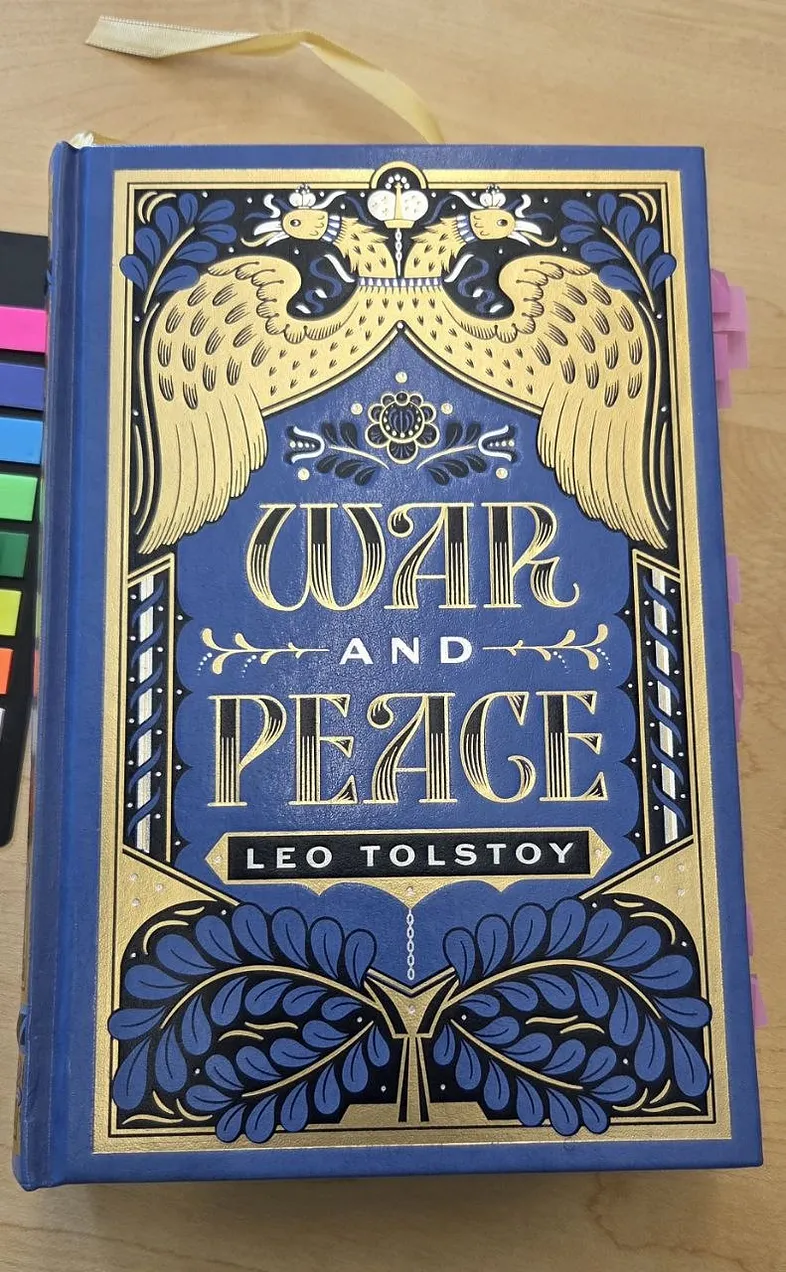
Man’s mind cannot grasp the causes of events in their completeness, but the desire to find those causes is implanted in man’s soul. And without considering the multiplicity and complexity of the conditions, any one of which taken separately may seem to be the cause, he snatches at the first approximation to cause what seems to him intelligible, and says, ‘This is the cause”. — Leo Tolstoy, War and Peace
Okay Octopus.
This brilliant guy, Leo Tolstoy, would be the death of my literary classic read. I’ve now survived Anna Karenina and War and Peace once; twice might be an overkill. Maybe next, I’ll settle for The Death of Ivan Ilyich, short, sharp, and mercifully manageable. And yet, beyond the humor, there’s something in War and Peace that lingers and refuses to let go.
Man cannot possess anything as long as he fears death. But to him who does not fear it, everything belongs. If there was no suffering, man would not know his limits, would not know himself.” ― Leo Tolstoy, War and Peace.
War and Peace is one of those novels you live with and not merely read. It moves through battles and drawing rooms, history, private lives, and questions that never settle. It asks about fate, love, family, and purpose, but never neatly, never fully resolved. It is such a chaotically beautiful read!
The winter of 1812, during Napoleon’s invasion of Russia, is where Tolstoy becomes both intimate and immense. Snow, cold, and endless motion shape every scene, both the sweep of armies and the quiet interior lives of those caught in history’s tide.
Kutuzov stands out immediately. He is not a man of grand gestures or loud proclamations. He reads novels, enjoys society, smiles quietly, and says almost nothing about himself. Yet beneath this unassuming exterior lies a rare clarity: he discerns the will of providence and aligns his actions with it, submitting personal will to something larger. Tolstoy presents him as patient, experienced, and deeply engaged with history, simple yet powerful. I am learning to be more of a modern Kutuzov.
War here is not only a strategy or battle; it is a stage where human passions, errors, and moral choices collide with the inexorable movement of time. Every deed, however small, becomes irrevocable, merging with countless others to shape history. Even those living “consciously for themselves” are instruments in something far greater, where personal will, fate, and history intertwine beyond comprehension.
Amid the snow and the war, Tolstoy never lets go of quieter truths: love, patience, reflection, and the reality that happiness exists in the moments we seize, even as chaos swirls around us. What lingered most was the recurring theme of uncertainty. Can a person ever be at peace when something within is unsettled? Can you remain calm if you feel deeply? Tolstoy resists easy answers. Right and wrong, cause and consequence, he shows we barely understand any of it, even as we crave certainty.
Influence is a kind of currency to be spent carefully. The higher one rises, the more entangled one becomes with others.
I kept returning to its simple, almost obvious truths: seize happiness, love, and be loved. Everything else, status, certainty, even history, feels secondary. And yet, consequences never fade. Our actions blend with those of millions, shaping history whether we mean to or not.
Tolstoy also treats patience and time as real forces and the only reliable powers we truly hold. He also touches deeply on love, arguably one of the greatest forces that emerges steadily beyond the shifting tides of human feeling. More so, even in war, love endures, and is central to life itself.
Where Piranesi was inward and searching, The Housemaid Is Watching was tense and suspicious, Thank You for Arguing and Why We Remember explained thought and action, War and Peace steps back. It asks not only how we live, but what any of it means from a distance. It offers no clean answers, only the truth that the higher we reach for understanding, the more escapes us.
Until the ink calls me back, I’ll see you between the pages.